It’s hard not to be moved by the beauty of the Leaning Tower of Pisa. This famous landmark has become one of the most iconic symbols of Tuscany and Italy, and it can be admired from both the outside and the inside. Here, you’ll find valuable information about the Leaning Tower of Pisa, including tips to help you plan your visit.
Table of Contents
The Pisa Tower: A Must-See Attraction in Tuscany
From a distance, you’ll see the leaning tower behind a high wall that once protected the historic center of Pisa. Your heart will start to race as you approach it.
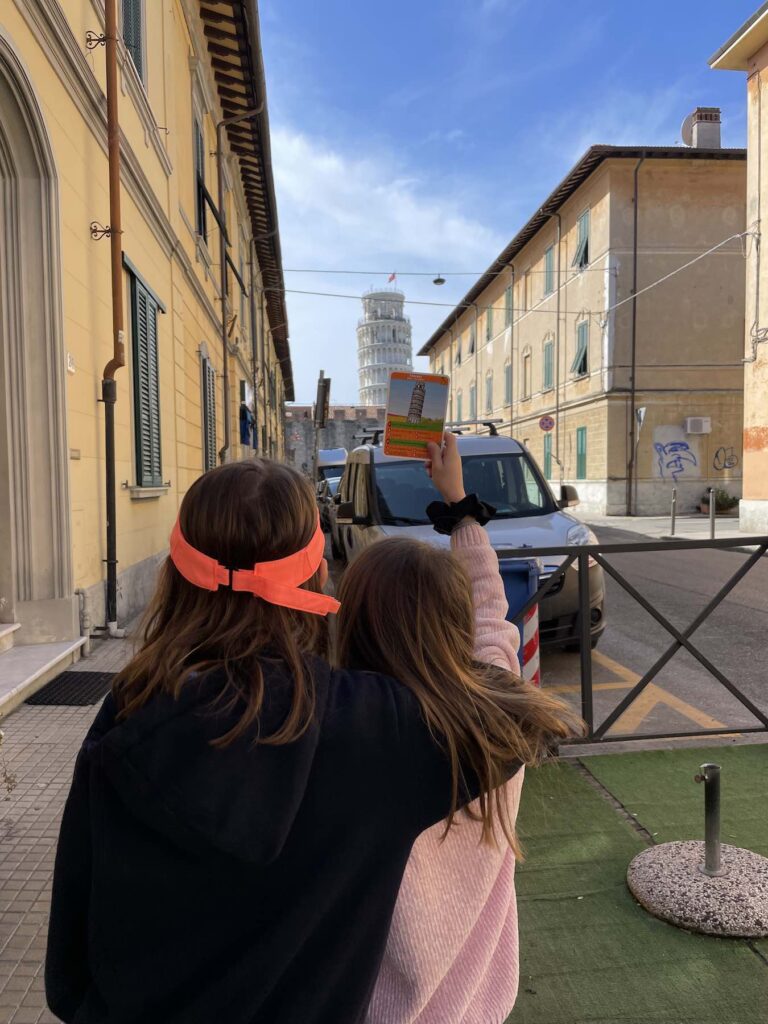
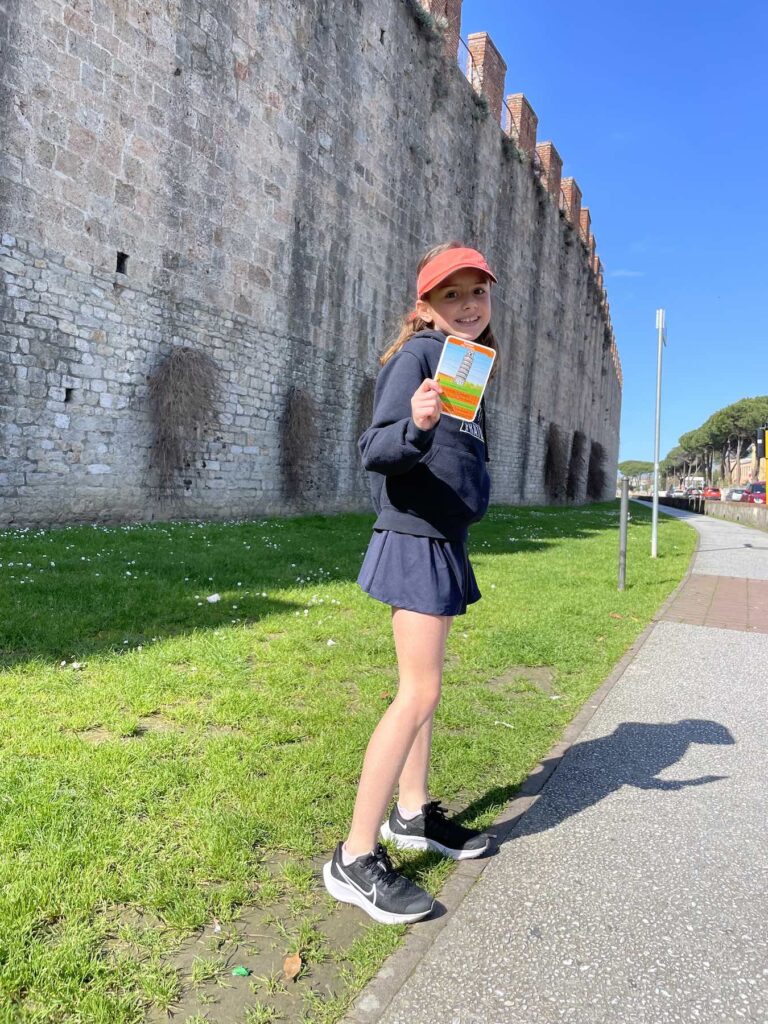
During a visit with my kids in April 2023, they brought a card from one of their games that had all the essential information about the tower.
Some interesting facts about the Tower of Pisa: it’s 58.36 meters tall (approximately 191.47 feet), has an outer diameter of 15 meters (49.21 feet), and weighs 14,453 tons. The current angle of inclination is approximately 5.115 degrees.

After admiring the tower’s beauty, which appears to sink on one side into the ground, it’s almost irresistible to take those classic photos pushing the tower with your hands, feet, or even hugging it. Is it a tourist thing? Yes. But who says being a tourist is boring? Plus, it’s always nice to take photos for posterity, isn’t it?
Our visit was brief, lasting just over an hour, because one of my daughters had a tennis tournament at lunchtime. But for you, if it’s your first time visiting Pisa, you can spend the whole day there at Piazza dei Miracoli (Square of Miracles), visiting other attractions such as the cathedral, the Baptistery, or even climbing the walls of the historic center to explore the city from above.
Group tours to Pisa from cities like Florence usually dedicate half a day to Pisa (6 hours, including travel time).
Inside the Leaning Tower of Pisa
If you’re wondering if you can go inside the Leaning Tower of Pisa, the answer is yes, you can. However, you need to purchase a ticket with a scheduled time slot.
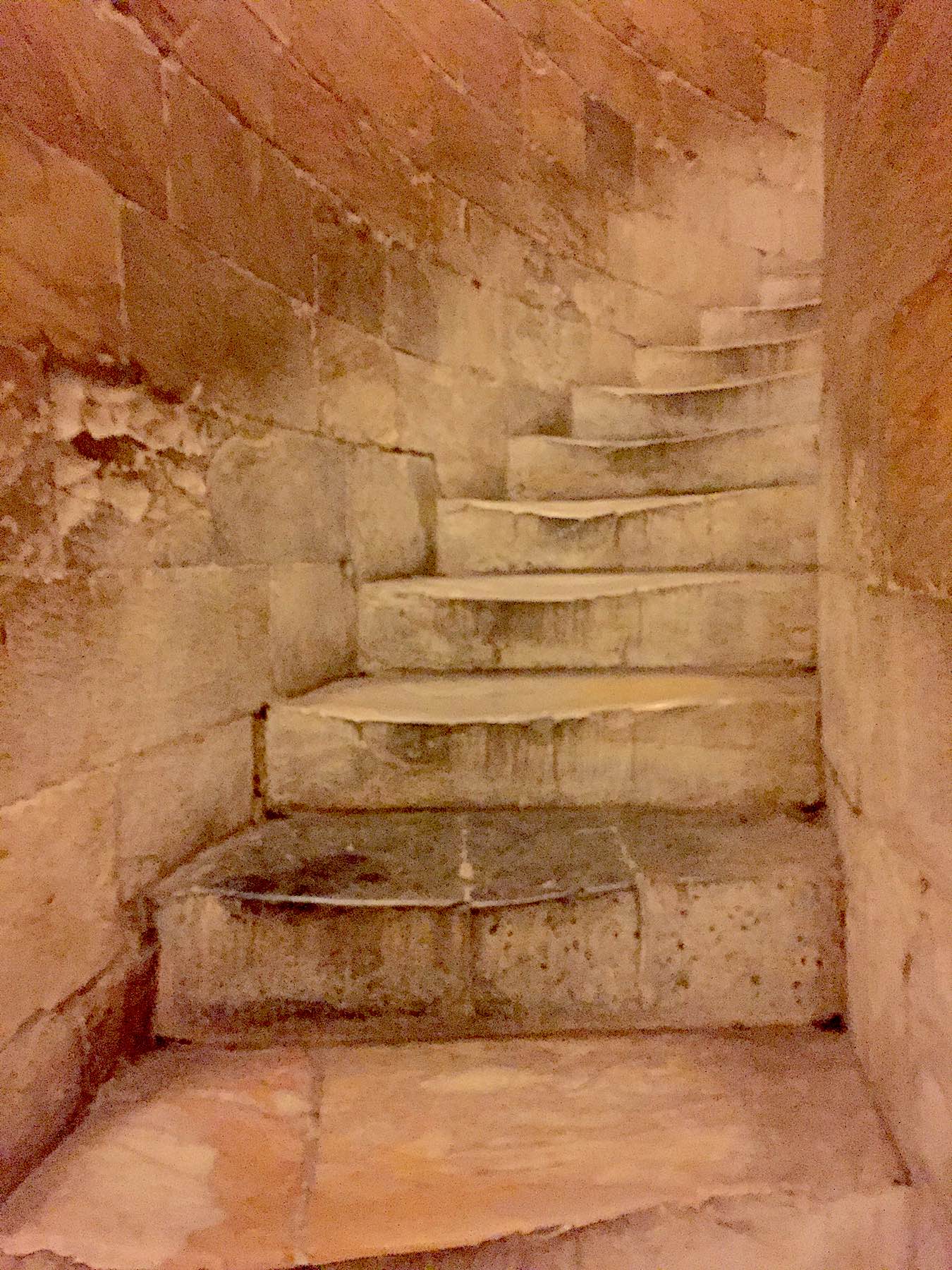
What’s it like inside the Tower of Pisa? When you enter the Tower, you’ll see a staircase with 273 steps.
My advice is to pay close attention to where you place your feet because the steps are irregular and crooked, and you might get hurt if you’re not careful, which could ruin the rest of your trip, right?
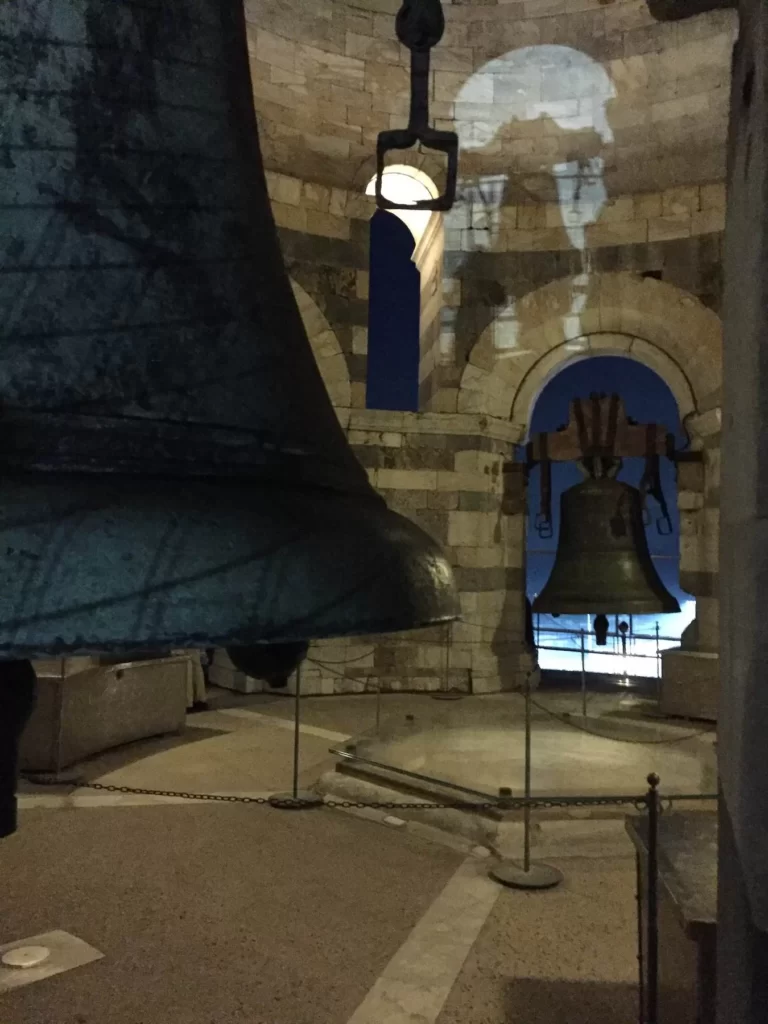
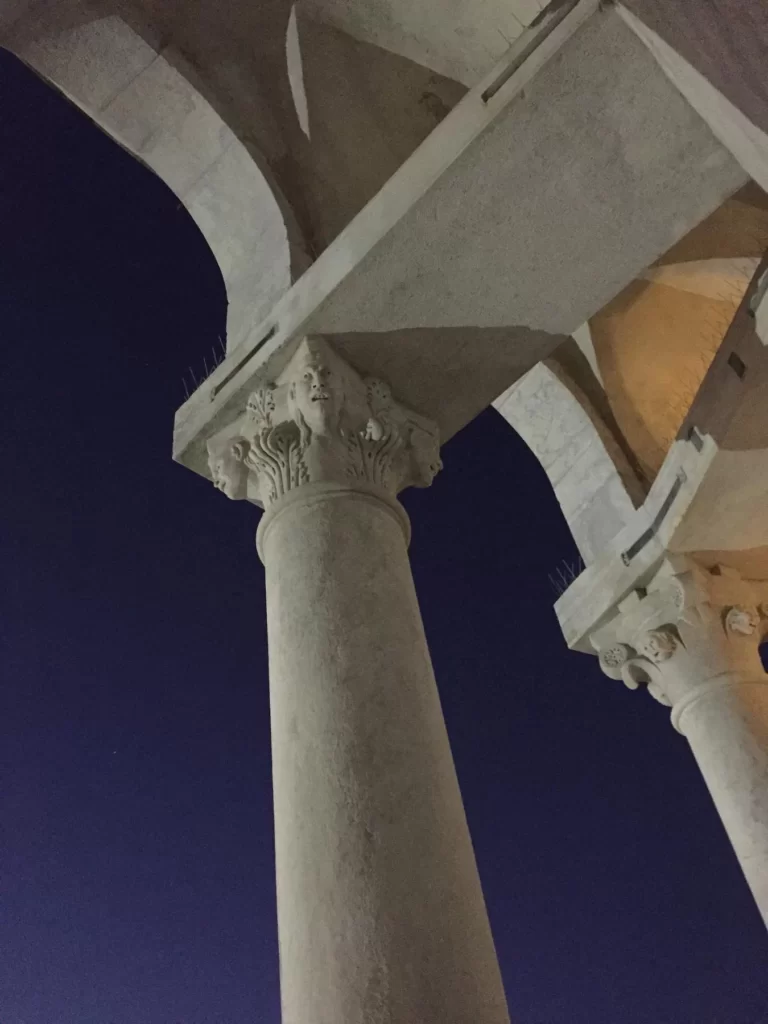
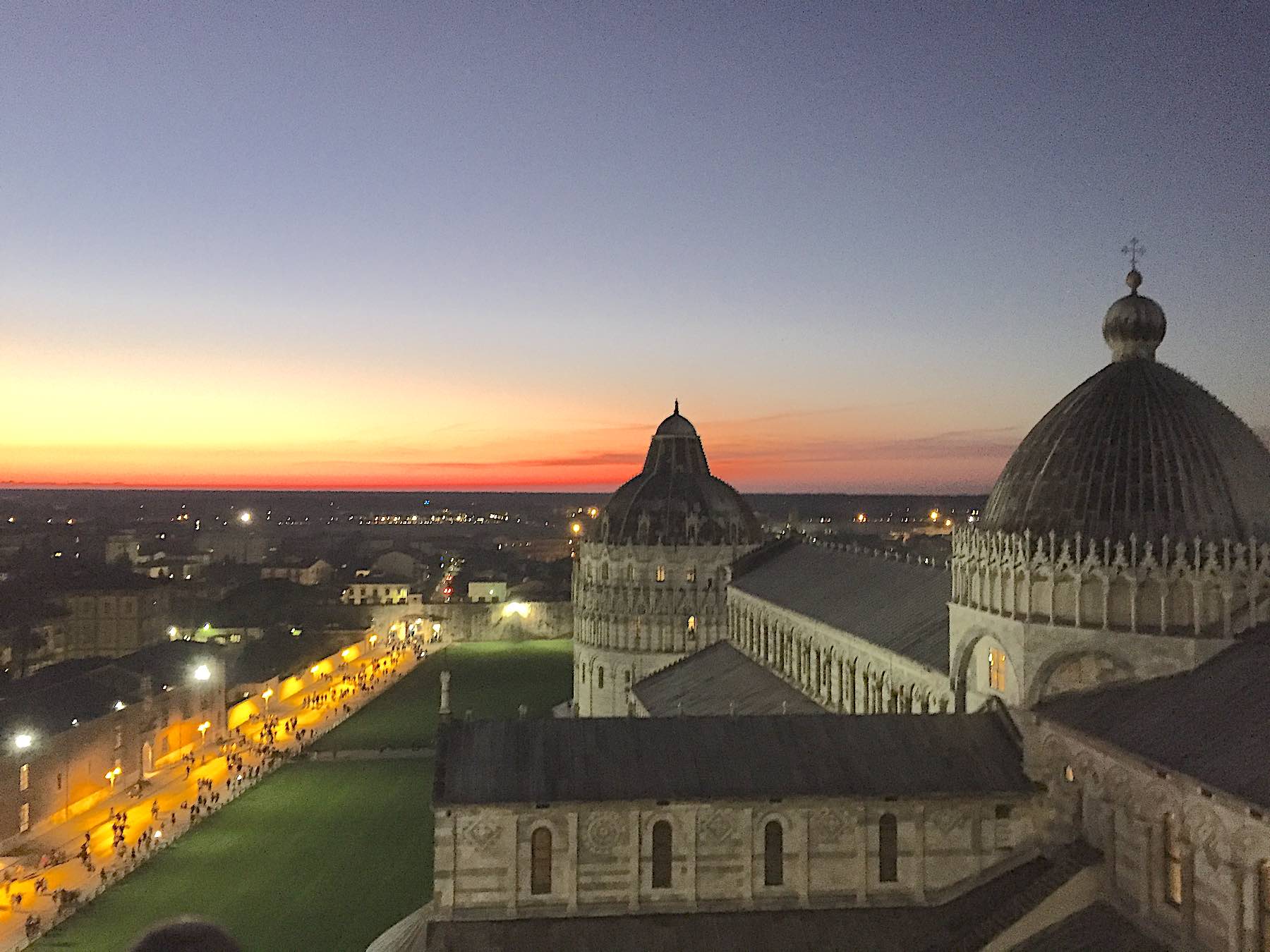
At the top, you’ll find the bells of the Tower, get a close look at the details of the columns, and admire the beautiful view of the city of Pisa and the adjacent cathedral.
Remember that it gets dark earlier in winter: December is the month with the shortest days, and it gets dark around 4:40 pm. June is the month with the longest days, and it gets dark around 9:00 pm.
Although it’s romantic to climb the Tower of Pisa at night, for a first-time visit, I personally recommend going during the day so that you can admire the beautiful view and take photos. At night, you can enjoy the city lights.
Attention, travelers with kids: children under 8 years old are not allowed to climb the Tower of Pisa!
If you’re planning to climb the famous Tower of Pisa in Italy, it’s important to know where to leave your backpack or other personal belongings before your ascent. Fortunately, the L’Opera della Primaziale Pisana offers a free baggage check service for Tower visitors.
Upon arrival, make sure you’re 15 minutes early for your printed ticket time, and leave your bags and luggage in the care of the baggage check staff. They will take care of your bulky items and provide you with a box and key. Remember the number of your box, as this will be useful when retrieving your belongings later.
At the end of your visit, remember to present your electronic key to retrieve your belongings from the baggage check. It’s important to note that the baggage check service follows
Opening Hours of the Tower of Pisa
What You Need to Know
The good news: the Tower of Pisa opens every day of the year.
The catch: closing time changes several times a year, and the swing is wide. A winter afternoon ends two hours earlier than a summer one, so check your own date before you book.
The official calendar published by the Opera della Primaziale Pisana, the body that runs the monuments in Piazza dei Miracoli, now runs through January 6th, 2027. These are the Tower’s hours up to December 20th; for the holiday period, check the official calendar closer to your date:
| Dates | Tower opening hours |
|---|---|
| Through October 18th, 2026 | 9:00 AM to 8:00 PM |
| October 19th to November 1st, 2026 | 9:00 AM to 7:00 PM |
| November 2nd to December 3rd, 2026 | 9:00 AM to 6:00 PM |
| December 4th to 7th, 2026 | 9:00 AM to 7:00 PM |
| December 8th to 20th, 2026 | 9:00 AM to 6:00 PM |
Last admission is always 30 minutes before closing, all year round. In practice, the last climbing slot on an October day is 7:30 PM, and on a November day it is 5:30 PM.
Summer runs later: between June 17th and August 31st, 2026, the monuments and museums in the square stayed open until 10:30 PM. The Tower closed early on three 2026 dates because of events in the square: June 16th, July 24th and August 9th.
Hours checked against the official Opera della Primaziale Pisana calendar on October 19th, 2026. The calendar is updated periodically, so confirm your date before booking.
The bad news is that climbing the Tower of Pisa is only possible with a timed-entry ticket. If you don’t reserve your ticket in advance, you’re unlikely to find availability for climbing the tower, especially during peak season.
My experience: On December 29th, 2019, I went to Pisa and it was such a beautiful day that I wanted to climb the Tower. But, of course, there was no availability at that time. I was only able to secure availability at the end of the day and caught the sunset from the top of the tower. I was lucky because it was winter and low season in Tuscany.”
Tickets for the Tower of Pisa
There are no discounted tickets available. For safety reasons, entry is not allowed for children under 8 years old (completed or to be completed in the current year). Visitors under 18 years old must be accompanied by an adult. A proof of age may be required.
| Type of ticket | Price | Online reservation |
|---|---|---|
| Tower + Cathedral | Euro 20.00 | buy here on the official website |
| Tower + Cathedral + Baptistery + Camposanto + Opera and Sinopie Museums | Euro 27.00 | buy here on the official website |
| Complete Visit: Cathedral + Baptistery + Camposanto + Opera and Sinopie Museums (no Tower) | Euro 11.00 | buy here on the official website |
| One monument of your choice (Baptistery, Camposanto, Opera del Duomo Museum or Sinopie Museum) + Cathedral | Euro 8.00 | buy here on the official website |
| Opera del Duomo Museum audio guide | Euro 5.00 | buy here on the official website |
It is also possible to book Tower of Pisa tickets online through Get Your Guide
Notice that the Cathedral appears in every row. Entry to it is free, and any ticket you buy for the square comes with an open, untimed Cathedral ticket attached. There is no Tower-only ticket.
If you are not climbing, or you are travelling with a child too young to climb, the Complete Visit at 11 euros covers the other four monuments. Most visitors never notice it exists.
Online tickets go on sale 90 days ahead and stay available up to the day of your visit. The ticket offices in the square open 30 minutes before the monuments and sell from 15 days ahead.
The chosen time is indicated on the ticket. Delay results in loss of visit and is not refundable. Bags must be left in the locker and retrieved at the end of the visit. The visit lasts about 30 minutes. The climb is made on foot and has 273 steps. Visitors will be greeted by the staff with a brief history of the Tower.
Changed your mind? An order that includes a Tower ticket can be changed or cancelled up to 2 hours before your time slot. Orders without the Tower can be cancelled until midnight on the day of the visit. Unused tickets are not refunded.
Attention… the visit is not recommended for people with heart, circulation or mobility problems. The floor is uneven and slippery.
Free entry to the Tower of Pisa
Unlike other Italian attractions, the Tower of Pisa is not part of the Italian State Museums and does not offer free admission on the first Sunday of each month
Free visits are allowed only for people with disabilities and their companion. Due to the limited capacity and the large number of visitors, availability is limited to the hours before 10 am and after 6 pm. You must contact Opa Pisa by email at least 3 days in advance and instructions will be provided to take advantage of the free visit.
How to get to the Leaning Tower of Pisa
Pisa is one of the most important cities in the Tuscany region and offers many transportation options. The city has an airport (Pisa International Airport), several train stations, and is a destination for various group and private tours. Here are the main transportation options to visit the city:
Train
The main railway station in Pisa is called “Pisa Centrale“.
For example, if you’re traveling from Florence‘s Firenze S. M. Novella station, the journey to Pisa takes around 1 hour and the fare starts at €9.80 per person each way (from €19.60 for a round trip).
Train tickets can be purchased through the Trenitalia app or website or at the ticket offices of any Italian railway station. Another option is the fare comparison site Trainline, which checks train prices and timetables and also shows coach options, all on one platform.
From Pisa Centrale railway station, two city buses stop at the Tower: line 1 (Ospedale Cisanello to Park Pietrasantina) and line 21 (S. Giusto to I Passi). Both list a Torre di Pisa stop on the official Autolinee Toscane route.
If an older guide told you to catch the LAM Rossa or line 4, ignore it. Pisa reorganised its city network: the LAM Rossa no longer exists, and line 4 now runs Stazione to I Passi without going past the Tower.
A city bus ticket in Pisa costs Euro 2.00 bought in advance, through the app, the official Autolinee Toscane website or an authorised reseller, and Euro 3.00 paid to the driver on board. Pisa is a provincial capital, so the higher urbano capoluogo fare applies, not the cheaper one you may see quoted for smaller Tuscan towns.
There is an easier way to pay, and it saves you hunting for a tobacconist before you board: tip tap, Autolinee Toscane’s contactless system. Hold your credit, debit or prepaid card, your phone or your watch against the validator near the doors, wait for the beep and the green screen, and the ticket is bought on the spot.
Autolinee Toscane says the system runs on all of its buses and that the fare is not marked up: you buy on board without paying the driver’s surcharge.
On city routes, which is what you will use in Pisa, it is one tap, as you get on. On intercity, mixed and express routes the rule changes: tap on and tap off, because the second tap is what tells the system where you got out. Forget to tap off and you are charged the full line fare, all the way to the last stop.
Two catches if you are not travelling alone. One device pays for one passenger at a time, so a couple needs two separate means (a physical card and a phone, say) or the at bus app. And use the same card or device for both taps of a single journey. Receipts can be looked up and downloaded on the Autolinee Toscane website, with no account needed.
There is also another railway station in Pisa called “Pisa S. Rossore,” which is closer to the Leaning Tower and can be reached on foot in less than 10 minutes. The only thing is that for those leaving from Florence, for example, there are not always direct trains to Pisa S. Rossore, and sometimes it is necessary to change trains.
Coach
If the train timetable does not work for you, or you are coming from further afield, Pisa is well served by long-distance coaches. FlixBus runs routes linking Pisa to other Italian cities and to a number of destinations abroad, and fares are often lower than the train if you book early.
One thing to keep straight: this is the long-distance coach, the one that brings you to Pisa. Once you are in town, getting from the station to the Tower is the city bus described above, a different service with a different ticket.
Pisa Airport
If you arrive at Pisa Airport and want to visit the Leaning Tower of Pisa, you can take a taxi with a fixed fare of Euro 14.50 (see more details below) or use the Pisa Mover to get to Pisa Centrale railway station and take a bus to Piazza dei Miracoli.
With Pisa Mover, you take approximately 5 minutes to reach Pisa Centrale railway station and spend Euro 6.50 one way, or Euro 13.00 return, on the ticket, which can be purchased online on the official website or at an automatic ticket office at the airport.

The Pisa Mover provides a convenient transportation option to travel from Pisa Airport to Pisa Centrale railway station.
Taxi in Pisa
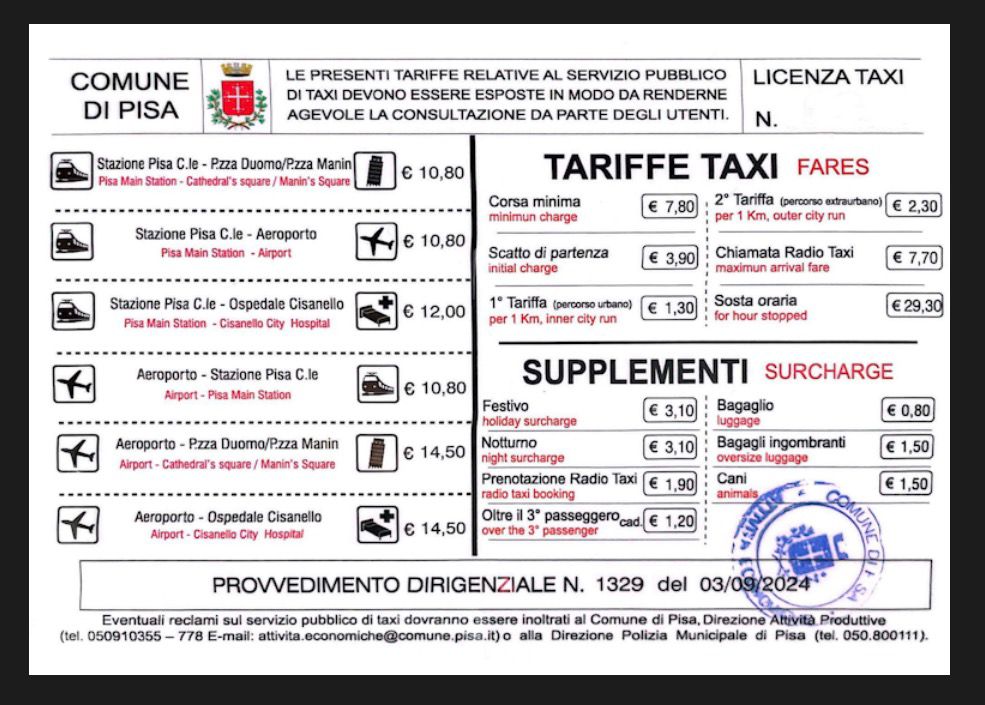
Those who prefer to go from Pisa railway station to the Tower by taxi will spend Euro 10.80 at the taxi stand. Those who choose to call a taxi (radiotaxi service) pay the meter fare with all supplements. The taxi cooperative in Pisa is called CoTaPi, and the telephone number is +39 050.541600.
These are the fixed taxi fares set by the city council:
- Pisa Centrale station to Piazza del Duomo or Piazza Manin: Euro 10.80
- Pisa Centrale station to the airport, and the other way round: Euro 10.80
- Airport to Piazza del Duomo or Piazza Manin: Euro 14.50
- Pisa Centrale station to Cisanello Hospital: Euro 12.00
- Airport to Cisanello Hospital: Euro 14.50
Off the fixed fares, the minimum charge is Euro 7.80 and the meter starts at Euro 3.90. Watch the surcharges, which stack: Euro 3.10 on Sundays and public holidays, Euro 3.10 at night, Euro 1.20 for each passenger beyond the third, Euro 0.80 per suitcase and Euro 1.50 for oversize luggage or for a dog. Calling a radio taxi adds up to Euro 7.70.
Car
The area around the Leaning Tower of Pisa and Piazza dei Miracoli is exclusively for pedestrians and authorized vehicles.
In some areas of the city of Pisa, vehicle traffic is limited, the so-called ZTL (Limited Traffic Zone). If you come across a sign that says ZTL, pay close attention to the dates when the area is open or closed to avoid fines.
You can use navigation apps like Waze or Google Maps to find the best way to the Leaning Tower of Pisa. There are parking lots around the Leaning Tower of Pisa, just follow the blue signs with a “P.”
Tours to the Leaning Tower of Pisa
There are several group tours available to visit Pisa and the leaning tower from the main cities in Tuscany. Here’s a selection of some options:
| Departs from: | To: | Duration | Rates (starting from): | Bookings |
|---|---|---|---|---|
| Florence | Pisa | 6 hrs | Euro 39.00 | Book here |
| Florence | Pisa and Lucca | 9hrs | Euro 65.00 | Book here |
| La Spezia | Pisa and Florence | 8-9hrs | Euro 54.00 | Book here |
| Livorno | Pisa and Florence | 8-9 hrs | Euro 43.00 | Book here |
| Montecatini | Pisa | 4 hrs | Euro 59.00 | Book here |
The History of the Leaning Tower of Pisa
Typically in Italy, towers were built for the purpose of defending the city. But this was not the case for the Leaning Tower of Pisa.
The tower was constructed as part of the religious complex of the cathedral square and served as a bell tower. The idea was to create a column of columns, circular like the Baptistry and visible from all points of the Pisan plain.
The tower, which has seven bells, one for each musical note, was responsible for marking time, both human and divine.
The largest of the seven bells was cast in 1655 and weighs an impressive three and a half tons.
Why is the Leaning Tower of Pisa Leaning?
Did you know that the Leaning Tower of Pisa was born leaning? The reason for its lean goes back to the time of its construction when the tower had only three floors.
The reason is linked to geology and a layer of clay with plastic behavior just below the square.
Construction of the Leaning Tower of Pisa began on August 9, 1173, during the era of the maritime republics, when Pisa was a rich and powerful city.

The tower’s foundations were left to rest for an entire year, but as soon as work on the third floor began, the ground under the tower gave way, causing it to lean dangerously. Why? The reason is linked to the so-called “pancone” under the Piazza dei Miracoli, a layer of clay with plastic behavior that gave way under the weight of the tower. This type of clay, which is found in this case about 7 meters deep, is called “normally consolidated.”
Several architects attempted to correct the lean, but without success. The tower was completed by the work of Tommaso Pisano only at the end of the 14th century. The lean, however, continued to grow over the centuries, becoming increasingly dangerous.
Between 1990 and 2001, the Leaning Tower of Pisa underwent one of the most important consolidation works in the world.
A commission of scientists from around the world developed a project that consisted of two phases: the first involved the use of lead weights and steel cables to stabilize the tower, while the second involved the removal of clay and sand from the opposite side of the lean, allowing for a slight sinking of about half a meter. The result was a return of the tower’s lean to a level similar to what it was about three hundred years ago.
If you enjoyed this article, you can support my work with a coffee here ☕
Another way to support Tuscany.Tips is by booking with one of our trusted partners below — at no extra cost to you.
FIND YOUR NEXT STAY
Book your stay in Italy or anywhere in the world with our partner Booking.com!
You'll find the best deals and support our website. Thank you!
BOOK TRANSFERS AND TOURS ONLINE
Book transfers, tours, and excursions in Italy and around the world with our partner Get Your Guide.
NEED DATA IN ITALY?
Get 5% off your Holafly eSIM with code TIPS—fast, easy, and reliable!