Donatello’s Statue in Florence – Italy is a country brimming with artistic treasures, and Florence stands as one of the epicenters of this cultural legacy. One of these treasures has now been restored to its former glory: Donatello’s bronze statue “Judith and Holofernes”, located in the Sala dei Gigli of the Palazzo Vecchio. Thanks to the support of the Friends of Florence organization, the sculpture underwent a meticulous restoration process that lasted about ten months, reviving its original grandeur.
Table of Contents
Donatello’s Statue in Florence: A Symbol of Freedom
Created between 1457 and 1464, the sculpture “Judith and Holofernes” is one of Donatello’s most remarkable works. Renowned for its powerful expressiveness, masterful technique, and intricate details, this piece has become a symbol of Florence’s liberty.
Interested in seeing the restored masterpiece in person? Here’s how to buy tickets for the Palazzo Vecchio.
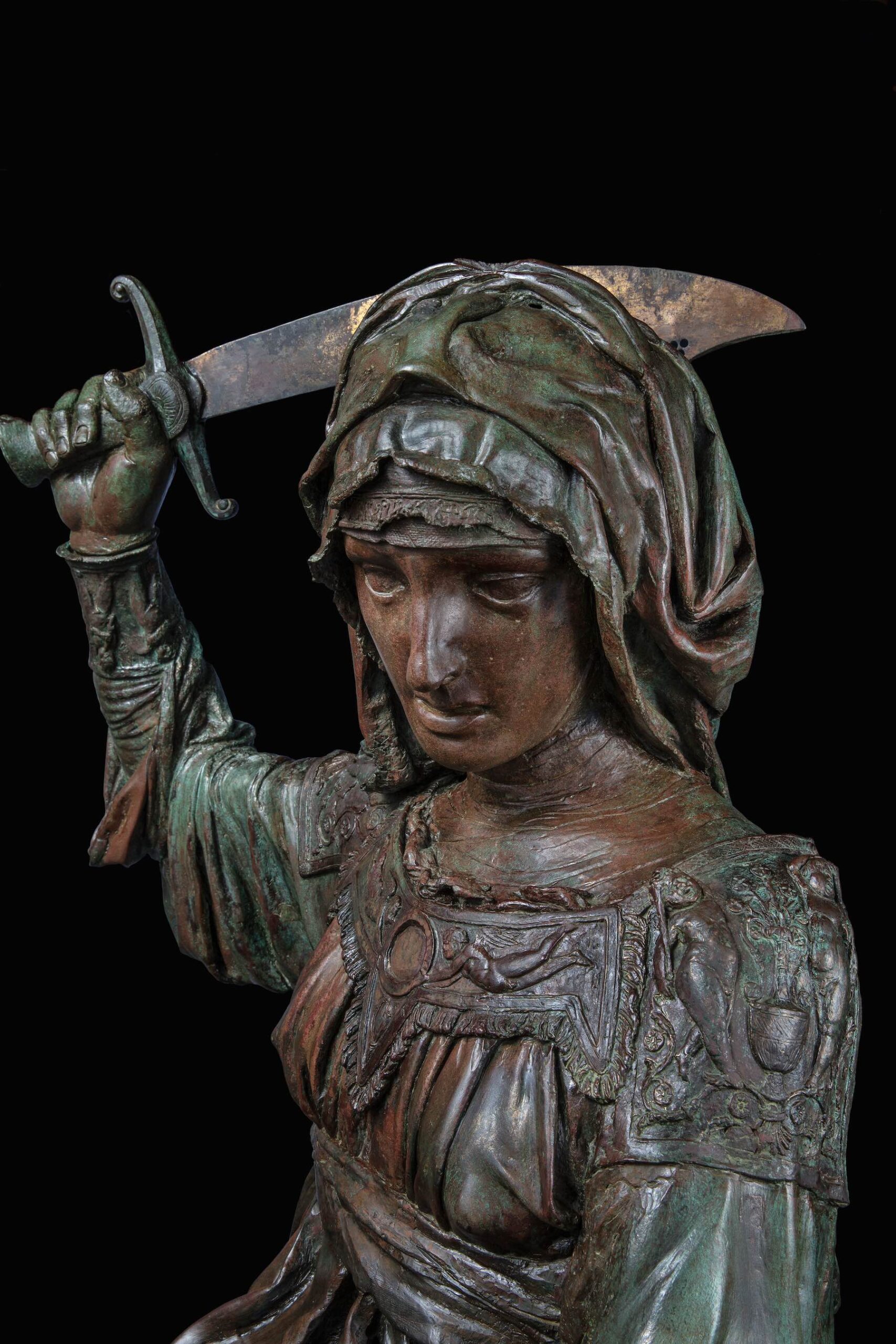
According to the most accepted hypothesis, the sculpture was commissioned by Piero de’ Medici around 1457.
The work was interrupted when the artist left for Siena and was completed between 1461 and 1464.
It was placed in the garden of the old Medici residence on Via Larga, now Palazzo Medici Riccardi, to contrast with Donatello’s bronze David, which was already in the nearby courtyard (now housed in the Bargello National Museum).
Donatello’s signature is engraved on the pillow on which the two characters rest.
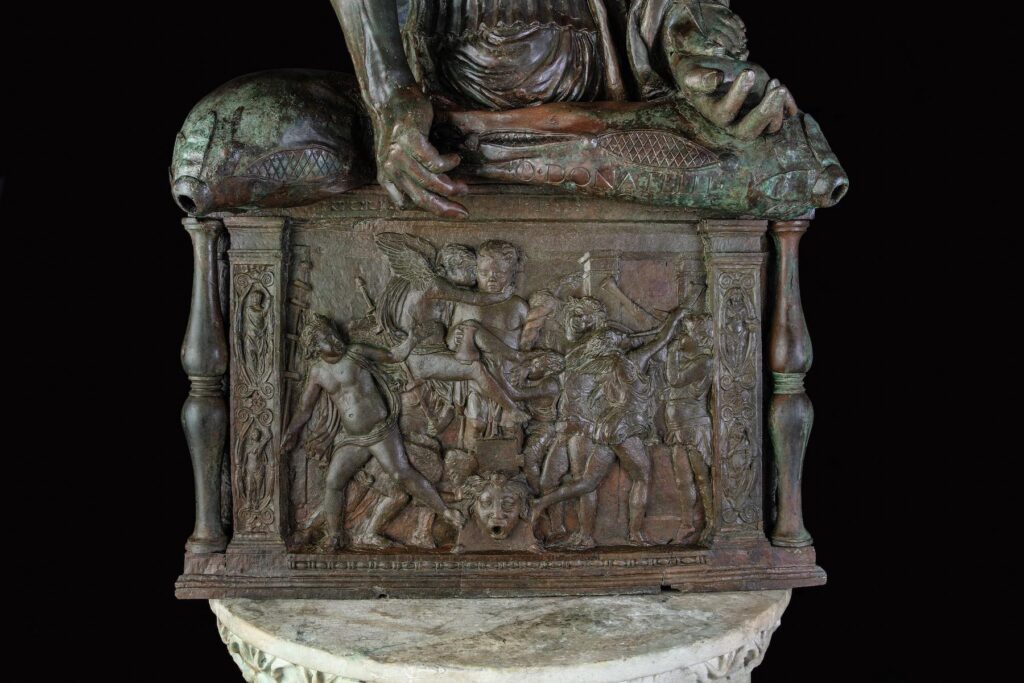
According to the biblical story, the young Jewish woman Judith saved her city from the siege of the Assyrian army by seducing and beheading General Holofernes. Traditionally, Judith was depicted triumphantly standing over her enemy’s severed head. However, Donatello added Holofernes’ figure, making it the first large-scale work to capture the action in progress.
Donatello portrayed the heroine standing tall and proud, holding the sword aloft, ready to strike the final blow. The tyrant’s lifeless body is trapped between Judith’s legs, with his limbs hanging pathetically from the bronze pedestal adorned with three bacchic reliefs symbolizing his lust. Originally, the bronze was embellished with gold, fragments of which still remain.
The sculpture reinterpreted the biblical narrative with a secular and political twist, as evidenced by two inscriptions on its base during its time in the Medici garden, which have since been lost:
- The first described it as a symbol of humility’s triumph over pride and virtue over lust.
- The second was a dedication from Piero de’ Medici, attributing the sculpture as a model of strength and liberty, encouraging citizens to emulate Judith in defending the Florentine Republic.
This second interpretation became predominant in 1495, a year after the Medici were expelled and a new Republic was proclaimed. The Florentine Signoria confiscated the sculpture and moved it to their government seat, replacing the original inscriptions with the current one marking the date of its transfer, thus solidifying the bronze as a symbol of Florentine freedom.
Judith was prominently displayed in the Palazzo della Signoria until 1504, when it was replaced by Michelangelo’s David. Judith was moved due to criticism that a woman killing a man was an unsuitable representation for the city and considered a harbinger of bad luck as Florence was losing control of Pisa at the time. Two years later, it was placed under the Loggia della Signoria but was moved to the Palazzo Vecchio’s central hall in 1919 after being safeguarded during the war.
Haven’t secured your accommodation yet? Check out our recommendations for hotels in Florence.

Except for safety reasons during World War II (1940-1946), when it was also restored by Bruno Bearzi at the behest of the Marinelli foundries, Judith has remained in place. After the Medici celebrations in 1980 revealed the bronze’s advanced state of degradation, it was replaced by a replica outside and transferred to the Sala dei Gigli. During this transfer, it underwent its first detailed scientific restoration by the Opificio delle Pietre Dure in Florence between 1986 and 1988.
The Recent Restoration of Judith and Holofernes
The recent restoration project was divided into two phases.
Initially, a detailed analysis of the sculpture’s condition was conducted, including a careful cleaning to remove accumulated dust.
The second phase involved deeper conservation work, using modern technologies such as laser to remove corrosion and reveal remaining gilded fragments. This process not only restored the statue’s original aesthetics but also provided new insights into Donatello’s techniques.
The Continued Legacy
The restoration of “Judith and Holofernes” is yet another example of the Friends of Florence‘s commitment to preserving and enhancing Florence’s artistic heritage. This project not only revived a Renaissance masterpiece but also underscored the importance of continuously protecting and studying these cultural treasures.
For visitors to Florence, the sculpture in the Sala dei Gigli is now a renewed testament to Donatello’s artistic prowess and the city’s vibrant history.
Visiting Florence and seeing the restored “Judith and Holofernes” offers an experience that bridges the present with the glorious past of the Italian Renaissance. It is an opportunity to appreciate art in its purest form and understand the value of ongoing cultural preservation efforts.
If you enjoyed this article, you can support my work with a coffee here ☕
Another way to support Tuscany.Tips is by booking with one of our trusted partners below — at no extra cost to you.
FIND YOUR NEXT STAY
Book your stay in Italy or anywhere in the world with our partner Booking.com!
You'll find the best deals and support our website. Thank you!
BOOK TRANSFERS AND TOURS ONLINE
Book transfers, tours, and excursions in Italy and around the world with our partner Get Your Guide.
NEED DATA IN ITALY?
Get 5% off your Holafly eSIM with code TIPS—fast, easy, and reliable!