Florence wine windows, known in Italian as buchette del vino, now appear everywhere on Instagram and TikTok. Travelers line up to receive a glass of wine through a tiny opening in a centuries-old wall, record the moment and share what looks like one of Florence’s most timeless traditions.
But here is the curious part: when I moved to Florence in 2005, practically nobody talked about them.
I lived in the city, walked through its historic center as part of my everyday life and worked in tourism in Tuscany, yet wine windows were not among the attractions visitors came to see. They already existed, of course, but most were closed, unmarked and so thoroughly absorbed into Florence’s architecture that residents and travelers could pass them without noticing.
The wine windows themselves are old. Their transformation into one of Florence’s most photographed experiences is not.
Table of Contents
What are the wine windows of Florence?
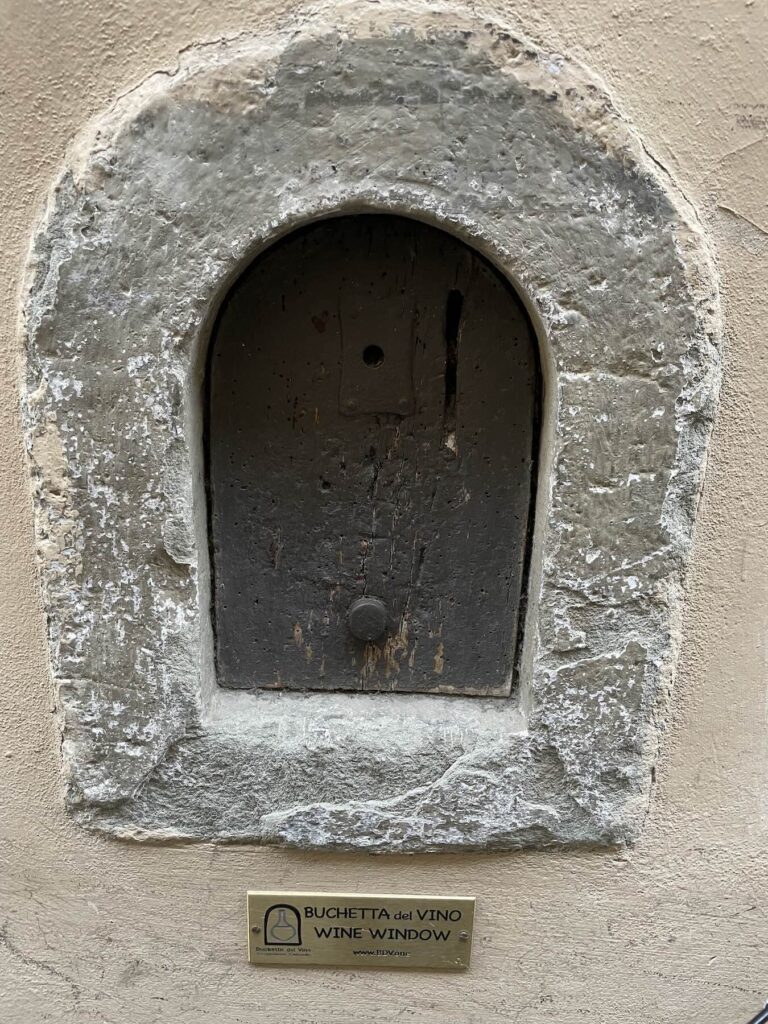
The buchette del vino are small openings built into the exterior walls of historic Florentine palaces and houses. Many have an arched or tabernacle-like shape and are fitted with a small wooden door.
They allowed wine-producing families to sell wine directly from their city residences to customers standing in the street. Instead of buying from a tavern or intermediary, the customer could knock on the shutter, place an order and receive wine through the opening.
The English-language website of the Wine Windows Association explains that these windows were generally located beside the main entrance of palaces belonging to wealthy landowners and were often connected to a cellar or storage room.
According to the association, they remained in occasional use into the early 20th century, meaning that wine was sold through them for roughly four centuries.
When did Florence’s wine windows first appear?
The precise origin of the wine windows is difficult to establish.
The Wine Windows Association connects their development to changes that took place after the Medici returned to power in Florence in 1532, when landowners were able to sell wine from their own production directly to customers. The architectural openings became a practical way to conduct those transactions from the family palace.
What is clear is that direct wine sales from private residences were already part of Florentine life during the Renaissance.
Over the following centuries, wine windows became a distinctive feature of Florence and other parts of Tuscany.
The association currently reports more than 190 wine windows in the Metropolitan City of Florence, including 165 in the historic center, as well as more than 120 in other Tuscan towns and cities.
Were wine windows invented during the plague?
Wine windows are frequently described on social media as an invention created during the plague. It is a compelling story, but it oversimplifies their history.
The direct sale of wine from the homes of landowners already existed before the 17th-century epidemics. During the plague that affected Florence between 1630 and 1633, however, this method of selling wine could also help reduce direct contact between sellers and customers.
A report published in 1634 by the Florentine scholar Francesco Rondinelli describes wine sellers avoiding direct contact with customers’ coins. Payment was placed on a small metal paddle, and the coins were subsequently disinfected with vinegar.
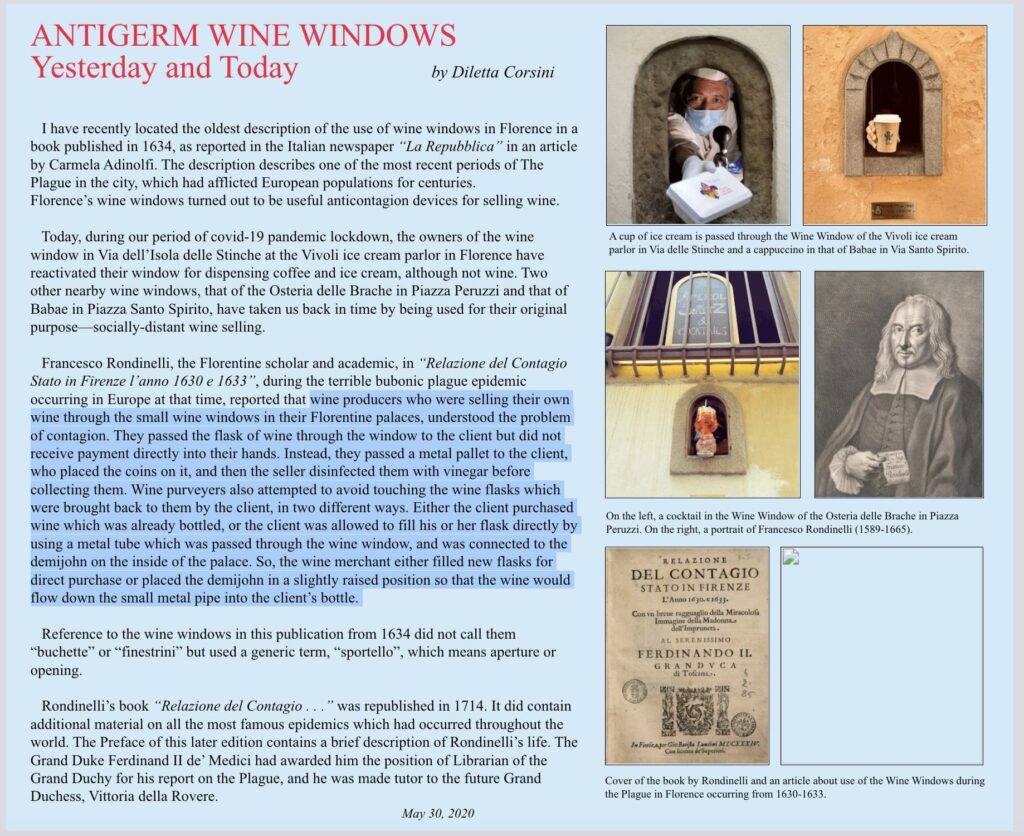
Sellers also tried to avoid handling the flasks brought by customers. Wine could be supplied already bottled or transferred into the customer’s container through a small metal tube connected to a larger vessel inside the building.
The historical document uses the general Italian word sportello, meaning an opening or hatch, rather than the later terms buchetta or finestrino. Nevertheless, it provides important evidence of how wine-selling openings were used to limit contact during an epidemic.
The Wine Windows Association provides a detailed account in its English article, “Antigerm Wine Windows: Yesterday and Today.”
Almost four centuries later, the connection between the old openings and contactless service would become a major part of their modern appeal.
Why did almost nobody talk about wine windows in 2005?
By the beginning of the 21st century, most wine windows had not been used for their original purpose for decades.
Some had been sealed. Others had been turned into doorbells, mailboxes or decorative niches. Many remained visible but were easy to miss, even for people who lived in Florence.
There were no viral videos, crowds waiting for a glass of wine or popular walking routes built around them. In a city dominated by the Duomo, the Uffizi Gallery, Ponte Vecchio and Michelangelo’s David, a closed opening in the wall of a palace did not automatically attract attention.

Living in Florence in 2005, I may well have passed several wine windows without realizing what they were.
The rediscovery began around 2015
About ten years later, things began to change. In October 2015, the Associazione Culturale Buchette del Vino was founded by Matteo Faglia, Diletta Corsini, and Mary Christine Forrest with the goal of researching, cataloging, protecting, and promoting these small historic windows.
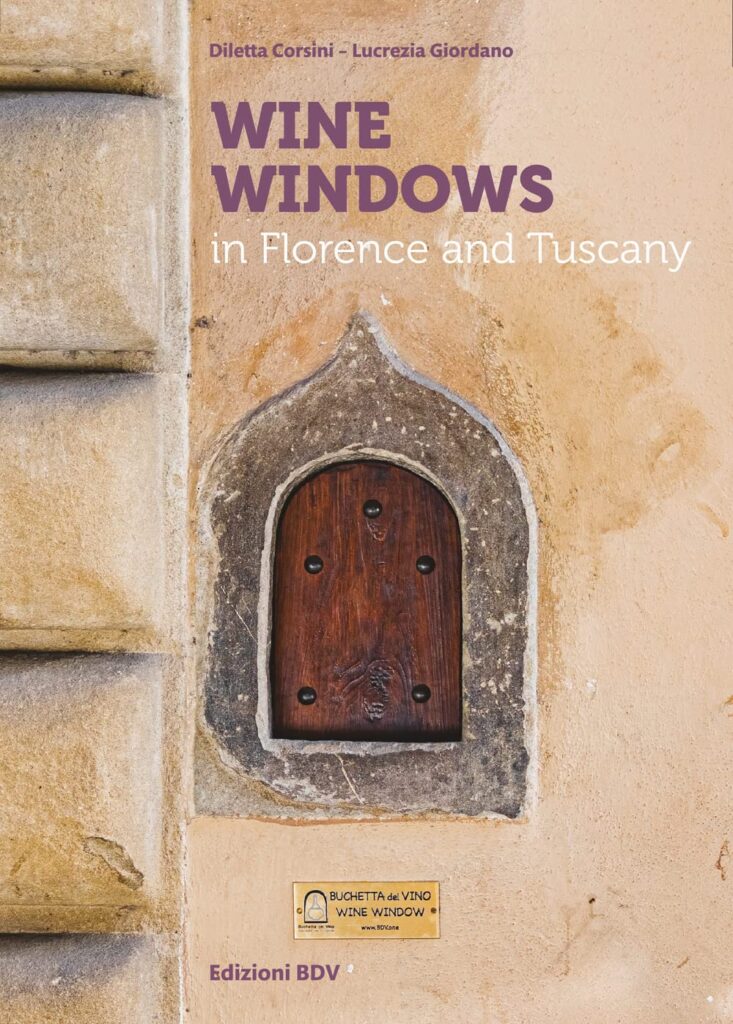
Thanks to that work, the buchette gradually began to emerge from obscurity. The association started locating surviving examples, studying historical documents, encouraging the installation of identification plaques, and drawing attention to a piece of local heritage that had remained almost invisible to both residents and visitors.
In 2021, the book featured images of 180 wine windows cataloged in Florence, along with another 100 still visible in other parts of Tuscany.
Babae brought a wine window back to life in 2019
A crucial moment in the modern revival came in 2019.
Babae, an osteria on Via di Santo Spirito in Florence’s Oltrarno district, reopened the historic wine window built into its exterior wall and began serving glasses of wine through it.
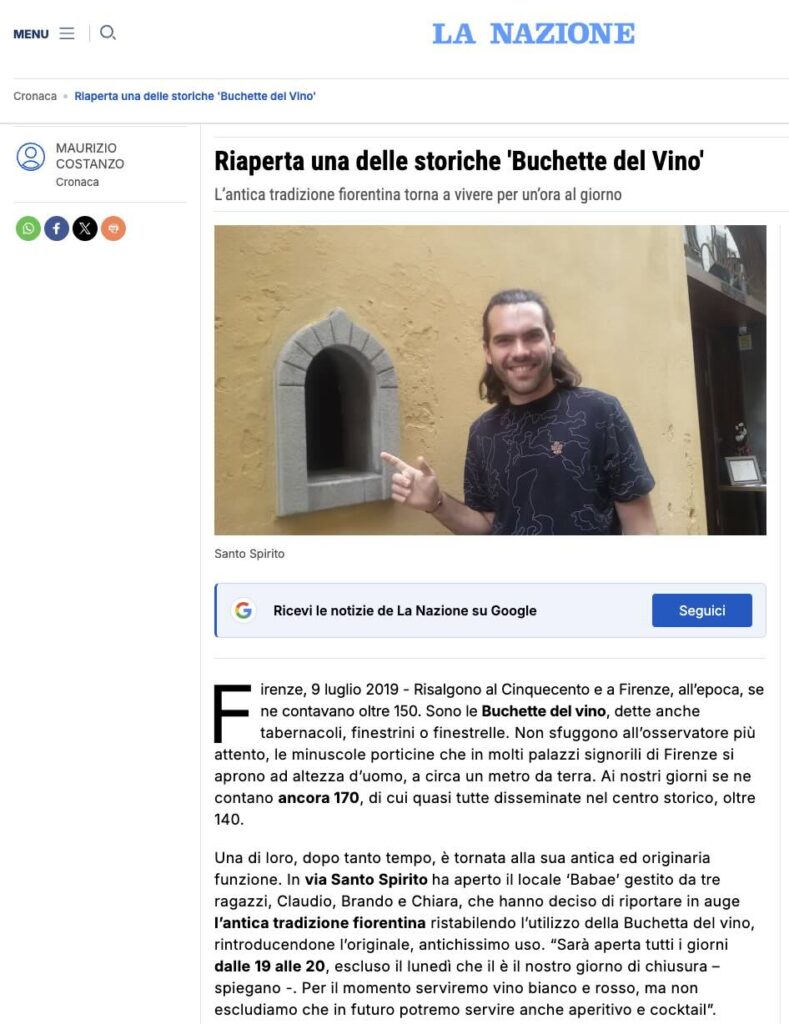
Travelers could approach the small shutter, place an order and receive a glass from a hand appearing through the opening.
The experience proved ideal for modern tourism: it was authentic, visually distinctive and easy to photograph.
A centuries-old architectural feature had become an experience.
The pandemic made Florence’s wine windows famous worldwide
Their international breakthrough came during the Covid-19 pandemic in 2020.
As businesses gradually reopened after Italy’s first lockdown, several establishments began using wine windows to serve customers while limiting close contact. The openings were used not only for wine but also for coffee, cocktails, sandwiches and gelato.
The historical parallel was irresistible. A system associated with contactless transactions during a 17th-century epidemic was being reused during a modern pandemic.
The Wine Windows Association recorded the reopening of windows at places including Vivoli, Babae and Osteria delle Brache. Its English-language account explains how the old openings once again became practical tools for serving customers from a distance.
International newspapers, television programs and travel websites picked up the story. Images of drinks being passed through tiny doors circulated around the world.
After remaining almost invisible for decades, Florence’s wine windows became global symbols of ingenuity, continuity and survival.
From forgotten openings to Instagram queues
Today, searching for wine windows has become an activity in its own right.
Some visitors turn it into a kind of treasure hunt through the historic center, looking for the tiny openings hidden in the façades of old palaces. Others prefer to head straight to the handful of places that still use a wine window to serve wine, drinks, or food.
And for travelers who would rather not hunt them down on their own, there are guided tours on GetYourGuide that include a stop at a buchetta del vino as part of the experience.
The scene seems designed for social media: an old stone wall, a tiny wooden door, a hand emerging with a glass of Tuscan wine and a traveler ready with a smartphone.
Instagram did not create the wine windows, but it changed the way travelers experience them.
Instead of being overlooked architectural details, they became small stages on which visitors perform and record their encounter with Florence.
Not every small wine-serving window is necessarily historical
The Wine Windows Association distinguishes historical Tuscan wine windows from newer openings inspired by them.
Its English website even includes examples of modern wine windows created in houses, taverns and restaurants outside Tuscany.
There are also openings in Florence that resemble genuine wine windows but may have had a different original function. The association notes that some have the expected shape, position and door without necessarily having been used for selling wine.
This does not mean that every newer opening is deliberately pretending to be ancient. It simply means that a small service hatch should not automatically be treated as a centuries-old buchetta del vino.
Travelers interested in the historical examples can consult the maps maintained by the Wine Windows Association.
Are the wine windows an authentic tradition or a tourist attraction?
They are both.
The historical tradition is real. These openings were part of Florence’s economic and social life for centuries, and the work carried out by researchers and the Wine Windows Association has helped protect a neglected part of the city’s architectural heritage.
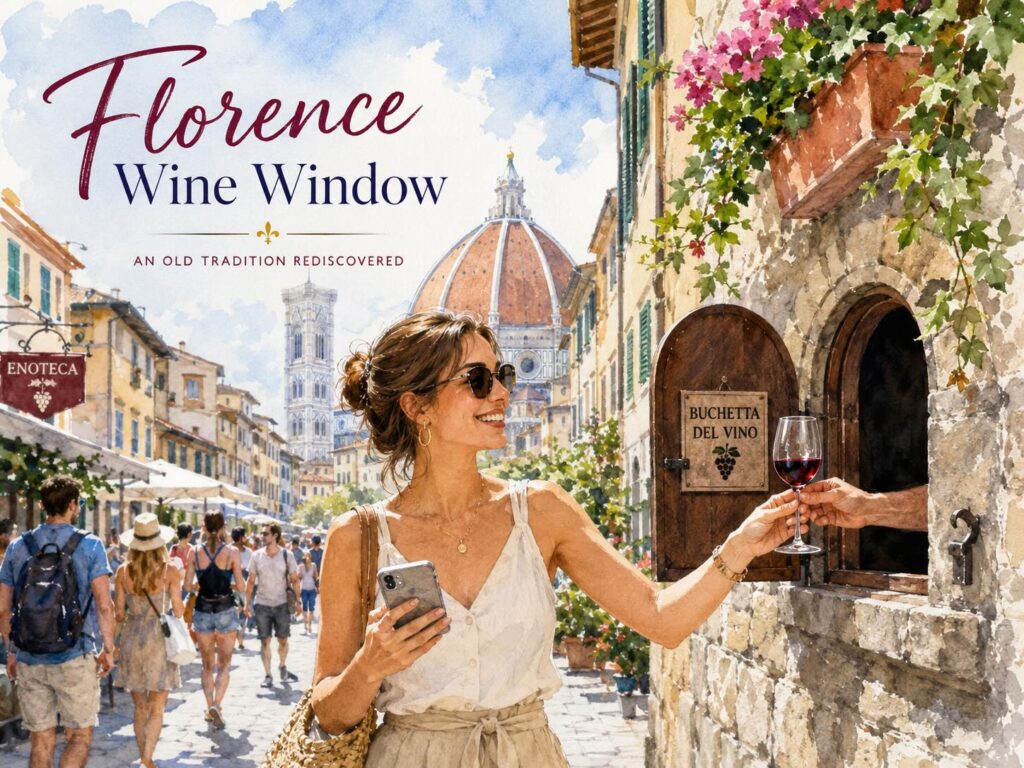
The modern experience, however, has clearly been shaped by tourism and social media.
At popular locations, people may wait in line not only for a glass of wine but also for the video of the glass appearing through the window. The transaction lasts only a few seconds, yet it creates an instantly recognizable Florence moment.
That does not make the tradition false.
It shows how heritage acquires new meanings. The windows once connected wine producers with local customers. Today, they also connect Florence with a worldwide audience.
The wine windows were always there
For people who knew Florence before the current revival, the sudden popularity of the buchette del vino can feel strange.
They seem to have appeared overnight, accompanied by travel guides, maps, Instagram reels and queues of visitors.
But the windows did not suddenly appear.
They were already embedded in Florence’s walls when I lived in the city in 2005. What did not yet exist was the widespread awareness, the identification plaques, the working service window and the visitor holding a phone in one hand while accepting a glass of wine with the other.
Florence’s wine windows are therefore a particularly contemporary phenomenon built around a genuinely old tradition: part architectural heritage, part historical rediscovery and part perfectly Instagrammable travel experience.
Once ignored, they have become almost impossible not to notice.
If you enjoyed this article, you can support my work with a coffee here ☕
Another way to support Tuscany.Tips is by booking with one of our trusted partners below — at no extra cost to you.
FIND YOUR NEXT STAY
Book your stay in Italy or anywhere in the world with our partner Booking.com!
You'll find the best deals and support our website. Thank you!
BOOK TRANSFERS AND TOURS ONLINE
Book transfers, tours, and excursions in Italy and around the world with our partner Get Your Guide.
NEED DATA IN ITALY?
Get 5% off your Holafly eSIM with code TIPS—fast, easy, and reliable!